
Labour Camp Catering Dubai: How to Feed Thousands of Workers Without Cutting Corners
Why Labour Camp Catering Is a Logistics Operation
Feeding a labour camp is not a catering job. It is a logistics operation with a catering component.
The scale alone changes everything. Thousands of meals, three times a day, every day, with no off days, no slow weeks, and no margin for a bad batch. Workers who are physically exhausted after a full shift do not have patience for cold food, short portions, or a menu that repeats itself until morale drops.
And in Dubai, where labour welfare standards are being watched more closely than ever, how you feed your workforce is not just an operational question. It is a compliance question. A welfare question. And increasingly, a reputational one.
Labour camp catering is one part of the wider industrial catering services in the UAE, where large workforces require reliable meal production, logistics, food safety, and daily operational planning.
This guide covers what labour camp catering in Dubai actually involves, what separates a contractor who can handle it from one who cannot, and what to confirm before you sign a contract.
What Labour Camp Catering in Dubai Actually Involves
A labour camp catering contract in Dubai is one of the most demanding catering operations in the region. The requirements are specific, the volume is high, and the consistency expected is unrelenting.
Three meals a day is the standard. Breakfast before the shift starts. Lunch during the break or delivered to the site. Dinner after work. Each meal needs to be hot, properly portioned, nutritionally adequate, and served or delivered on time. Every day. Seven days a week.
The workforce at most large labour camps in Dubai is multinational. South Asian workers make up the majority at most construction and industrial sites, with significant populations from Southeast Asia, Africa, and the Arab world. A single menu that ignores this diversity is a menu that leaves a significant portion of the workforce eating food that does not suit them. Morale drops. Complaints increase. And the catering contractor gets replaced.
A capable labour camp catering contractor in the UAE builds menus that rotate across the week, account for the primary nationalities in the camp, and deliver enough variety that workers are not eating the same meal on the same day every week. It is not complicated to describe. It requires genuine operational commitment to deliver.
What Dubai Requires from Labour Camp Catering Operations
Dubai has specific regulatory requirements that apply to worker accommodation catering. The Dubai Municipality Food Safety Department oversees food safety compliance for catering operations across the emirate, including those serving labour camps.
Every catering contractor operating in Dubai must hold a valid food establishment licence from Dubai Municipality. Food handlers must hold current food safety certifications. Kitchen facilities, whether on-site at the camp or at a central production kitchen, are subject to regular inspection.
Beyond food safety, the UAE’s worker welfare standards, increasingly enforced across major project contractors and developers, include provisions around meal quality and nutritional adequacy. A camp catering setup that provides technically safe but nutritionally inadequate food is not meeting these standards, even if it passes a food safety inspection.
For camp operators and main contractors in Dubai who are working on projects with international developers or government clients, worker welfare compliance is not optional. The catering contractor you choose is part of your compliance picture. Choose one who understands this.
The Difference Between a Labour Camp Caterer and a Standard Catering Company
Most catering companies can prepare a meal. Not all of them can prepare 3,000 meals three times a day, seven days a week, without the quality or the quantity slipping.
The difference shows up in a few specific areas.
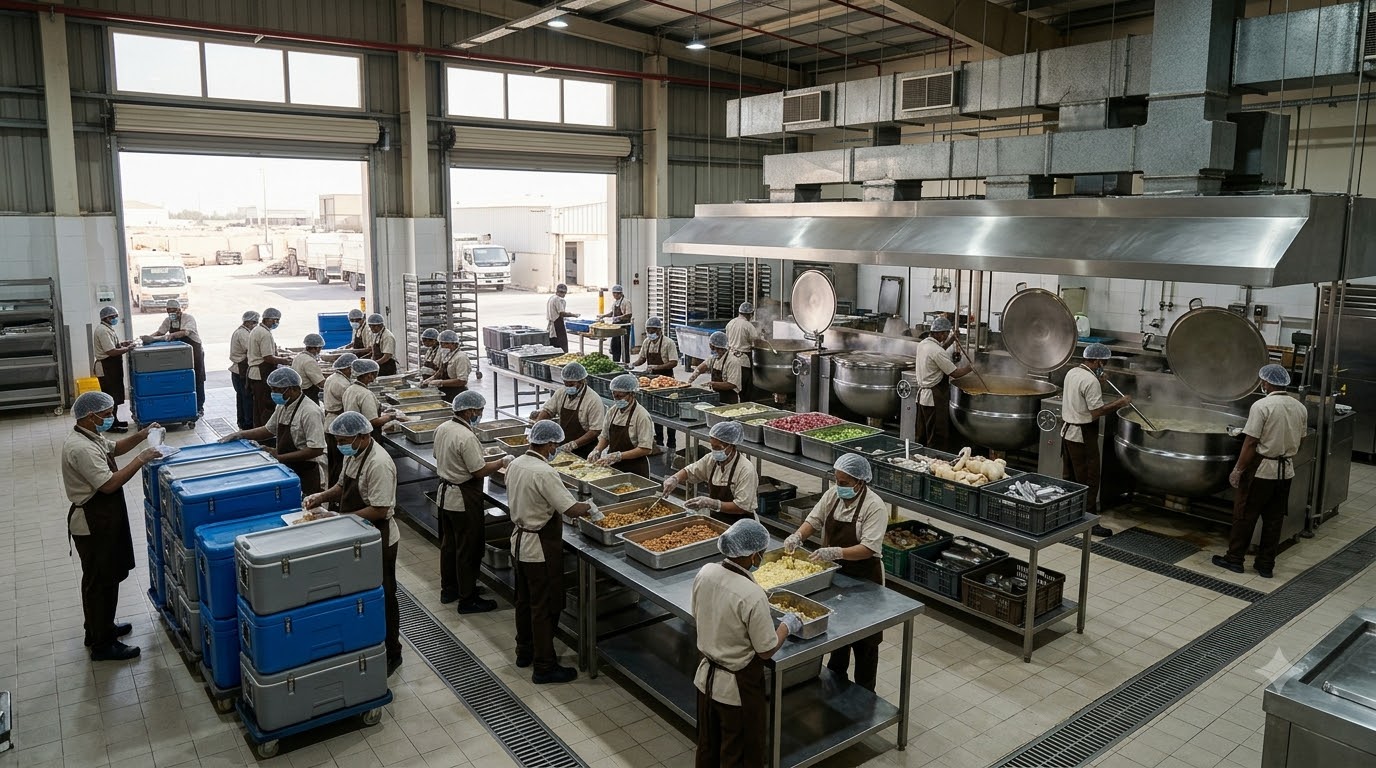
Production kitchen capacity. A labour camp catering contractor needs either an on-site kitchen at the camp large enough for the volume required, or a central production kitchen with the capacity to produce and dispatch the full meal count within the timing window for each meal service. Ask to see the kitchen. Ask about daily output capacity. A number on a proposal means nothing without the infrastructure to back it up.
Cold chain and transport. Meals produced at a central kitchen need to reach the camp hot. Not warm. Hot. In Dubai’s climate, food safety during transport is a genuine operational challenge. Temperature-controlled vehicles, sealed insulated containers sized for the meal count, and a delivery schedule that gets food from kitchen to table within the safe window are all non-negotiable.
Staffing model. A labour camp catering operation of any significant size needs dedicated kitchen staff, serving staff, and cleaning staff operating on a schedule that covers all three meal services. Ask about the staffing ratio for your camp size and what the contingency plan is when a staff member does not show up.
Procurement and supply chain. Feeding thousands of workers requires a procurement operation that can source ingredients in volume, consistently, at the quality required. A caterer who relies on daily market purchases for a camp of 2,000 workers is one supply disruption away from a meal service failure. Ask about their supply chain and their inventory management.
These requirements become even more important when catering reaches thousands of meals per day, as explained in this guide to bulk meal catering in the UAE.
These same production, staffing, procurement, and delivery challenges are central to industrial catering, where large workforces need reliable meals around their working schedules.
What a Good Labour Camp Meal Service in Dubai Looks Like
The best labour camp food supply operations in Dubai share a set of characteristics that separate them from average providers.
The menu rotates. A weekly rotation of breakfast, lunch, and dinner options means no worker is eating the same meal on the same day week after week. It sounds basic. A significant number of camp catering operations do not do it properly.
The portions are adequate. A construction worker doing eight to ten hours of physical labour needs enough food to fuel that work. Calorie-adequate, protein-sufficient portions are not a premium offering. They are the baseline standard. A catering contractor who consistently under-portions is one who is cutting costs in the most visible way possible.
The food is hot when it arrives. Every time. This requires temperature management from kitchen to service that is planned, monitored, and consistently executed. Not on most days. Every day.
The dietary diversity of the workforce is respected. A South Indian worker, a Pakistani worker, and a Filipino worker do not all want the same food. A good labour camp catering contractor plans menus that give the primary nationality groups in the camp food that is recognisable and satisfying to them, while maintaining a shared menu structure that is operationally manageable.
For more guidance on building balanced menus around workers’ nutritional needs, schedules, and food preferences, see this guide to staff accommodation catering in the UAE.
Hygiene is maintained throughout. The serving area is clean. The utensils are clean. The food storage is correct. These are not things that should need to be chased. They should be maintained as a standard without prompting.
How to Evaluate a Camp Catering Contractor in the UAE
When you are assessing labour camp meal services in Dubai for your camp or project, the conversation needs to go deeper than a price per meal.
Ask for the contractor’s current Dubai Municipality food establishment licence and a copy of their most recent inspection report. Ask for references from current labour camp contracts at a comparable meal volume. Ask to visit their production kitchen before signing. Ask about their cold chain management for transport. Ask for a sample weekly menu and assess whether it genuinely reflects the dietary diversity of your workforce.
You can also use these 17 questions to ask a workforce catering company in Dubai and Abu Dhabi when comparing catering providers and their operating capabilities.
Ask how they handle a meal service failure. What is the contingency if a delivery vehicle breaks down? What happens if an ingredient is unavailable? What is the response time if a meal count needs to be adjusted at short notice?
And ask about the contract terms in detail. Minimum meal commitments, adjustment periods for headcount changes, price escalation clauses for ingredient cost increases, and exit terms on both sides. These are the details that matter when the contract is running, and circumstances change.
XL Catering’s Labour Camp and Workforce Catering in the UAE
XL Catering provides labour camp catering services across the UAE, including Dubai, with the production capacity, logistics infrastructure, and operational experience to handle high-volume worker accommodation catering at scale.
Every camp catering contract starts with a site assessment. Workforce size, nationality breakdown, shift patterns, meal timing requirements, on-site infrastructure, and compliance requirements are all assessed before a proposal is developed.
Menus are planned for nutritional adequacy and diversity across the week, with full halal certification and rotation that accounts for the primary nationality groups in the workforce. Food safety compliance is maintained to Dubai Municipality standards, with documentation available and inspections welcomed.
The operational model, whether on-site kitchen setup, central kitchen delivery, or a hybrid, is chosen based on what the camp’s infrastructure and location actually require.
Get in touch with XL Catering to discuss your labour camp catering requirements in Dubai and receive a tailored proposal based on your camp size and operational needs.
Frequently Asked Questions
- What does labour camp catering in Dubai include?
Three meals a day, seven days a week, covering breakfast, lunch, and dinner. A full contract includes menu planning, fresh preparation, delivery or on-site service, and compliance with Dubai Municipality food safety standards. - What are the regulatory requirements for labour camp meal services in Dubai?
Catering contractors must hold a valid Dubai Municipality food establishment licence, employ food handlers with current safety certifications, and maintain kitchen facilities that meet inspection standards. Worker welfare provisions around nutritional adequacy also apply. - How do I choose the right camp catering contractor in the UAE?
Ask for their current operating licence, inspection history, references from comparable contracts, kitchen visit access, sample menus, cold chain management details, and clear contract terms on meal number flexibility and price escalation. - How is labour camp catering in Dubai priced?
Per meal or per head per day rates are standard. Price depends on meal count, menu complexity, service model, camp location, and contract length. Always get an itemised breakdown and understand what happens to pricing when headcount changes. - Can labour camp catering in Dubai accommodate a multinational workforce?
A capable contractor can. Menu planning for a diverse workforce needs to account for South Asian, Southeast Asian, Arab, and African dietary preferences alongside halal requirements. Ask for a sample weekly menu before committing to any provider. - What is the difference between on-site kitchen catering and central kitchen delivery for labour camps in Dubai?
On-site kitchen catering means the contractor operates a kitchen at the camp. Central kitchen delivery means meals are produced elsewhere and transported to the camp. The right model depends on the camp’s infrastructure, location, and meal volume. - How does a labour camp catering contractor handle meal number changes in Dubai?
This should be specified in the contract. Ask about the notice period required for headcount adjustments, whether there is a minimum meal commitment, and how under- or over-delivery is handled. Understand this before signing. - What cold chain management is required for labour camp food supply in Dubai?
Hot food must travel in temperature-controlled, sealed containers that maintain safe serving temperatures from kitchen to camp. In Dubai’s climate, this is a genuine operational challenge. Ask your contractor specifically how they manage this for your delivery distance. - Does XL Catering provide labour camp catering services in Dubai?
Yes. XL Catering provides labour camp and workforce catering across the UAE, including Dubai, with on-site and central kitchen delivery models, full halal certification, and compliance with Dubai Municipality food safety standards. - How much notice does a labour camp catering contractor need to start operations in Dubai?
For on-site kitchen setup, four to six weeks is standard. For central kitchen delivery, two to three weeks is typically sufficient. Confirm the mobilisation timeline during the proposal stage so it aligns with your project schedule.
