
Bulk Meal Catering UAE: How XL Catering Delivers 8,000 Meals a Day Without Losing Quality
What 8,000 Meals a Day Really Means for Bulk Catering
8,000 meals a day is not a number most people can picture.
It is 333 meals an hour. It is a full production kitchen running across multiple shifts. It is a procurement operation that sources ingredients in tonnage, not kilograms. It is a fleet of vehicles leaving the kitchen in coordinated waves timed to shift breaks across multiple sites. It is a team of people who treat consistency not as a goal but as the only acceptable outcome.
Bulk meal catering in the UAE is one of the most operationally demanding food service models in the region. This guide explains what it takes to do it properly, where most high-volume operations fall short, and how XL Catering maintains quality at a scale that most providers cannot sustain.
Why Bulk Meal Catering in the UAE Is Its Own Category
The UAE’s workforce catering market is unlike most in the world. A combination of massive construction pipelines, large industrial facilities, extensive labour accommodation, and a multinational workforce that spans dozens of nationalities creates a demand for high-volume food service that is both enormous and specific.
Catering for 5,000 workers in the UAE is not the same as running a large restaurant. It is not the same as managing a hotel banquet operation. It is a manufacturing-level food production challenge with catering-level quality expectations.
For a broader look at how this model works across factories, labour camps, and other large facilities, see this guide to industrial catering services in the UAE.
The failure modes are different too. A restaurant that has a bad night affects a few dozen customers. A bulk meal catering operation that fails on delivery affects thousands of workers who have no alternative and whose employers now have a welfare compliance problem on their hands.
This is why mass catering in the UAE demands a provider built specifically for this scale, with the infrastructure, the systems, and the operational discipline that high-volume food service requires.
What a High-Volume Food Service Operation Actually Looks Like
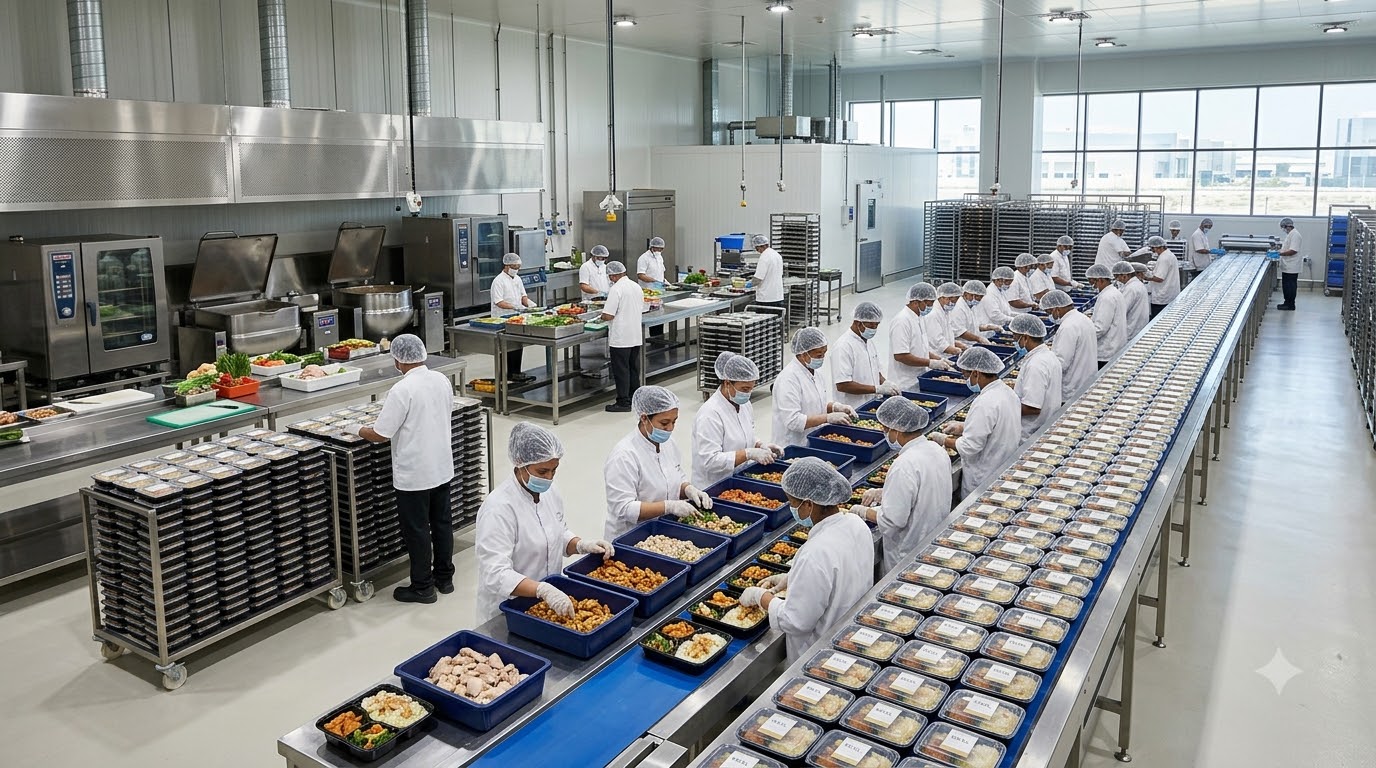
Most clients who commission bulk meal catering in the UAE never see the operation behind their contract. Here is what a properly run large-scale meal production facility in the UAE looks like.
The production kitchen.
A kitchen producing 8,000 meals a day is not a bigger version of a regular kitchen. It is a food production facility. Industrial cooking equipment running across coordinated production lines. A prep team starting work hours before the first meal dispatch. A quality control checkpoint before food leaves the kitchen. Temperature monitoring at every stage from cooking to packing.
The kitchen operates on a production schedule, not a cooking schedule. Every dish for every meal across every site is planned, prepped, cooked, packed, and dispatched within a sequence that leaves no gaps. A delay at any point in the chain creates a knock-on effect that hits the delivery window at the other end.
Large workforce operations with residential worker accommodation have additional requirements, which are covered in our guide to labour camp catering in Dubai.
Procurement at scale.
Sourcing ingredients for 8,000 daily meals requires supplier relationships that go well beyond a standard catering procurement model. Volume contracts with approved suppliers. Inventory management that maintains the right stock levels without waste. A contingency supply chain for when a primary supplier cannot deliver.
In the UAE’s import-heavy food market, procurement reliability is one of the biggest differentiators between bulk meal catering providers. A caterer who does not have locked supply agreements for their core ingredients is one commodity shortage away from a meal service failure.
Transport and logistics.
Food leaving a central production kitchen needs to reach multiple sites, at the right temperature, within the delivery window for each shift. For an operation producing 8,000 meals a day across multiple locations, this means a managed fleet with a precise dispatch schedule.
Temperature-controlled vehicles. Sealed insulated containers sized for each delivery. A dispatch sequence that accounts for travel time to each site. A tracking system that identifies delays before they become failures. These are not optional features of a high-volume catering operation. They are the operational baseline.
This is also what separates industrial catering in the UAE from ordinary catering, where production, delivery, and meal service must operate around an ongoing workforce schedule.
Where High-Volume Catering Operations Lose Quality
Quality loss in bulk meal catering is rarely dramatic. It happens gradually. Portion sizes creep down. Ingredient quality gets quietly reduced. Menu variety shrinks as the operation prioritises what is easiest to produce at volume.
By the time the client notices, the decline has been happening for weeks.
The most common pressure points where quality erodes in large-scale meal production in the UAE are these.
Portion control under pressure. When a kitchen is running behind schedule, the instinct is to move faster. Moving faster with food means less attention to portion weight. Over time, meals that should be 400 grams are consistently coming in at 320. Workers notice. They always notice.
Ingredient substitution. A primary ingredient is out of stock or has spiked in price. The kitchen substitutes a cheaper alternative without informing the client. This happens more than most clients realise and is one of the clearest signs of a provider managing their margin at the client’s expense.
Menu repetition. A menu that was designed with a weekly rotation gets compressed into a three-day rotation because it is operationally easier. Workers end up eating the same meals more frequently than the contract specifies. Morale drops. Complaints increase.
Temperature failure at the end of the delivery chain. The food leaves the kitchen hot. The first deliveries arrive hot. The last deliveries on the route, the sites furthest from the kitchen, arrive warm at best. This is a cold chain management failure that is common in operations that have grown their delivery radius without upgrading their logistics.
How XL Catering Maintains Quality at 8,000 Meals a Day?
XL Catering’s approach to bulk meal catering in the UAE is built around the premise that scale is not an excuse for quality reduction. Here is how that commitment translates into operational practice.
Standardised portion control. Every meal is portioned to a confirmed weight before it leaves the kitchen. This is not a spot check. It is a production line standard. Portion weights are logged and audited as part of the daily kitchen operation.
Locked supplier agreements. XL Catering’s procurement is built on volume contracts with approved halal-certified suppliers. Ingredient substitutions without client notification do not happen. If a supply issue requires a menu adjustment, the client is informed in advance, and the change is agreed before the meal is produced.
Rotating weekly menus. The weekly menu rotation confirmed at the contract stage is the menu that runs. It does not compress over time. It does not simplify to favour kitchen convenience. The variety committed to in the proposal is the variety delivered across the contract.
End-to-end temperature management. From cooking to packing to transport to delivery, XL Catering’s cold chain management is monitored and logged. Temperature data for every delivery is available on request. The last delivery on the route arrives at the same standard as the first.
Regular client reporting. Meal counts, delivery logs, temperature records, and menu compliance reports are provided to clients on a schedule agreed at the contract stage. Quality is not something clients have to chase. It is documented and shared as a standard part of the service.
Who XL Catering’s Bulk Meal Catering Service Is Built For
The clients who get the most value from XL Catering’s high-volume food service in Abu Dhabi and across the UAE are operating at a scale where meal service reliability directly affects their core business.
Construction main contractors with large labour accommodation on long-duration projects. Industrial facilities with shift-based workforces that need consistent meal provision across multiple daily services. Government and semi-government entities managing large workforce feeding programmes. Developers with worker welfare compliance obligations built into their project contracts.
For teams living in company accommodation, meal planning also needs to account for staff accommodation catering in the UAE, including balanced nutrition, meal schedules, food preferences, and safe food delivery.
For businesses evaluating providers, understanding the practical requirements of workforce catering in Dubai and Abu Dhabi can help identify the right service model for large teams.
If a meal service failure at your operation creates a welfare compliance issue, a workforce productivity problem, or a contractual breach, you need a bulk meal catering provider who treats reliability as a non-negotiable output. Not a goal. An output.
What to Expect When You Engage XL Catering for Bulk Meal Catering?
The engagement process starts with a site assessment and a detailed operational brief. Meal count, service locations, shift patterns, delivery windows, workforce nationality breakdown, dietary requirements, on-site infrastructure, and compliance obligations are all assessed before a proposal is developed.
The proposal is itemised and transparent. Per-meal pricing is confirmed against a specified menu and portion standard. Contract terms on meal number flexibility, price adjustment mechanisms, and reporting obligations are all clearly defined.
A mobilisation timeline is agreed based on the scale of the operation and whether on-site infrastructure setup is required. For new large-scale contracts, a transition period is built in to ensure the first day of service runs as smoothly as day 100.
Get in touch with XL Catering to discuss your bulk meal catering requirements in the UAE and receive a proposal tailored to your operation’s scale and specifications.
Frequently Asked Questions
- What is bulk meal catering in the UAE and who needs it?
Bulk meal catering covers high-volume daily meal production for large workforces, including construction labour camps, industrial facilities, and government workforce programmes. Any operation where thousands of workers need consistent daily meals needs a provider built for this scale. - How does XL Catering maintain quality across 8,000 meals a day?
Through standardised portion control, locked supplier agreements, rotating weekly menus that do not compress over time, end-to-end temperature management with logged data, and regular client reporting on meal counts and delivery standards. - What is the difference between bulk meal catering and standard event catering in the UAE?
Bulk meal catering is a daily production operation requiring manufacturing-level consistency, procurement at volume, and managed logistics across multiple sites. Event catering is a one-off or occasional service. The infrastructure, staffing, and operational model are completely different. - How is bulk meal catering priced in the UAE?
Per-meal or per-head-per-day rates are standard. Price depends on meal count, menu complexity, number of service locations, delivery distances, and contract length. Volume contracts at higher meal counts attract more competitive per-meal rates. - Can XL Catering handle catering for 5,000 workers in the UAE simultaneously?
Yes. XL Catering’s production capacity and logistics infrastructure are built for high-volume operations at this scale and beyond. Every large-scale contract starts with a site assessment to confirm the operational model that suits the client’s locations and shift patterns. - How does XL Catering manage food safety across high-volume meal production in Abu Dhabi?
Through temperature monitoring at every production stage, sealed temperature-controlled transport, logged delivery data, and full compliance with Abu Dhabi Public Health Authority food safety standards. Documentation is available to clients on request. - What happens if a delivery is delayed in a bulk meal catering operation?
XL Catering’s logistics model includes contingency planning for delivery delays. Clients are notified immediately if a delivery is running behind schedule, and the operational response is activated before the delay affects the meal service window. - How does XL Catering handle ingredient price increases in a long-term bulk catering contract?
Price adjustment mechanisms are defined in the contract at the outset. Any ingredient cost increase that triggers a price review is communicated to the client with full transparency. Substitutions without client notification do not happen. - What is the mobilisation timeline for a new bulk meal catering contract with XL Catering in the UAE?
For central kitchen delivery operations, two to three weeks is typically sufficient. For contracts requiring on-site kitchen setup, four to six weeks is standard. The mobilisation timeline is agreed at the proposal stage and built into the contract. - Does XL Catering provide bulk meal catering outside Abu Dhabi across the UAE?
Yes. XL Catering operates across the UAE with logistics infrastructure built for multi-site delivery. Service coverage and delivery radius are confirmed at the site assessment stage based on the client’s location and operational requirements.
