
The Complete Guide to Industrial Catering Services in the UAE
Why Industrial Catering Matters for UAE Workforces
Running a factory, a construction site, or a large facility in the UAE comes with a long list of operational responsibilities. Feeding the workforce is one that does not get enough attention until it becomes a problem.
When it goes wrong, it goes wrong visibly. Meal delays slow down shift handovers. Poor food quality affects morale. Inadequate portions leave workers underfuelled for physically demanding roles. And a catering setup that does not meet UAE food safety standards creates compliance risks that no facility manager wants to deal with.
Industrial catering services in the UAE exist to take this entire responsibility off the operator’s plate. This guide covers what industrial catering actually involves, what to look for in a provider, and how to make the right decision for your workforce.
What Industrial Catering Services in the UAE Actually Cover
Industrial catering is not the same as event catering or restaurant service. The scale is different, the environment is different, and the operational requirements are different.
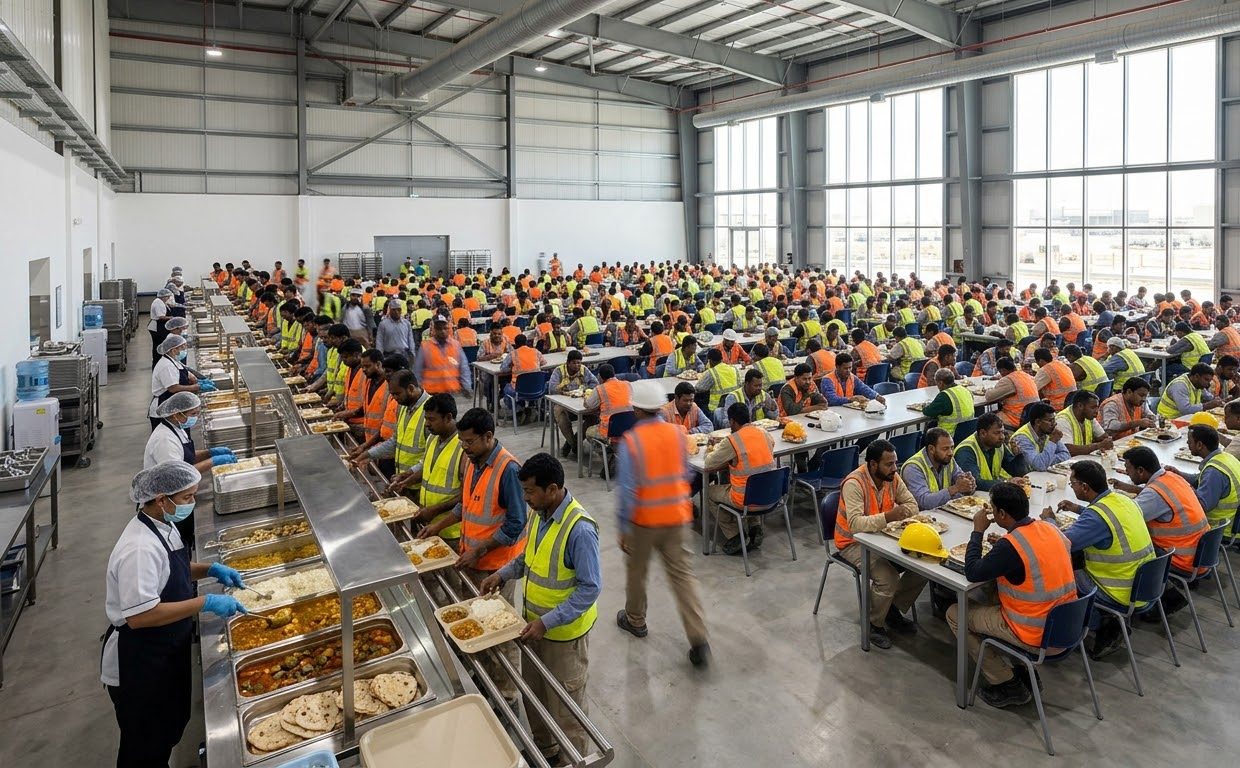
At its core, industrial catering means providing consistent, nutritious, high-volume meals to a workforce on a scheduled basis. That might mean three meals a day for a residential labour camp. It might mean a single shift meal for a factory floor of 500 workers. It might mean canteen management for a corporate facility with mixed-collar staff eating at different times across the day.
For a practical look at how industrial catering works during a typical working day, see What Is Industrial Catering and Why Your Workforce Deserves Better Than a Basic Canteen?
What stays consistent across all of these is the need for reliability. A catering provider that delivers 90 percent of the time is not good enough for an industrial operation. The 10 percent of failures are shift disruptions, worker complaints, and management headaches. Industrial catering needs to work every single day, at the right time, at the right quality, at the right quantity.
In the UAE, industrial catering services typically cover one or more of the following formats.
Labour Camp Catering
Full-day meal provision for residential worker accommodation. Breakfast, lunch, and dinner are prepared and served on-site or delivered to the camp. Menu planning, nutritional balance, and portion sizing are all managed by the catering provider. This is the most common format for construction projects and large industrial facilities outside Abu Dhabi’s city centre.
For a closer look at the operational challenges of feeding large residential workforces, see this guide to labour camp catering in Dubai.
Factory and Facility Canteen Management
On-site canteen operation for manufacturing plants, warehouses, and processing facilities. The catering company manages the kitchen, the staff, the menu, the procurement, and the daily operation. The facility operator gets a functioning canteen without managing any of it directly.
Shift Meal Delivery
Bulk meal delivery timed to shift schedules. Hot meals arrive at the facility in time for the shift break, portioned and ready to serve. No on-site kitchen required. This is a practical option for facilities without dedicated canteen infrastructure.
Executive and Mixed-Level Catering
Some industrial facilities have a split workforce, blue-collar workers on the floor and white-collar management and engineers in offices. A capable industrial caterer manages both, with separate menus and service formats suited to each group within the same facility.
What the UAE Specifically Requires from Industrial Catering Providers
Operating industrial catering services in the UAE is not just a logistical question. It is a regulatory one.
The UAE has specific food safety standards that apply to all catering operations, including industrial ones. Providers must hold the necessary permits from the relevant municipal authority, whether the Abu Dhabi Public Health Authority, Dubai Municipality, or the relevant emirate body. Food handlers must hold valid food safety certifications. Kitchen facilities, whether on-site or at a central production kitchen, must pass regular inspections.
For labour camp catering specifically, the UAE has guidelines around nutritional standards and meal provision for workers. These are not suggestions. Facilities that do not meet these standards face compliance issues that carry real operational and reputational consequences.
When you are evaluating industrial catering companies in Abu Dhabi or elsewhere in the UAE, ask directly about their regulatory compliance. Ask for copies of their current permits. Ask when their last food safety inspection was conducted and what the outcome was. A provider operating at the standard the UAE requires will answer these questions without hesitation.
What to Look for in an Industrial Catering Company in the UAE
The industrial catering market in the UAE has a significant number of providers operating across different scales and specialisations. Choosing the right one comes down to a clear set of criteria.
Proven High-Volume Capacity
Industrial catering for a workforce of 500 is fundamentally different from catering for 50. The kitchen infrastructure, the procurement relationships, the transport logistics, and the staffing model all need to be built for the volume you require. Ask every provider you consider for their daily meal output capacity and for references from clients at a comparable scale.
High-volume capacity becomes particularly important when a provider is handling thousands of meals every day, as discussed in this guide to bulk meal catering in the UAE.
For additional questions covering capacity, food safety, menus, delivery and pricing, see these 17 things to look for in a workforce catering company in Dubai and Abu Dhabi.
Menu Quality and Nutritional Standards
A workforce doing physically demanding work needs food that fuels that work. Adequate protein, sufficient calories, and a balanced nutrient profile are not optional extras. They are what keep a workforce productive across a full shift. Ask your caterer how their menus are designed, whether a nutritionist is involved in menu planning, and how they handle the dietary diversity of a UAE workforce that typically spans multiple nationalities.
For a more focused look at nutrition planning for employees living in company accommodation, see this guide to staff accommodation catering in the UAE.
Consistency Across Every Meal
One good meal a week is not industrial catering. It is industrial catering on a good day. Ask providers how they maintain consistency across every meal, every day. What quality control processes are in place? What happens when a key ingredient is unavailable? How are last-minute changes to meal numbers handled?
Flexibility on Meal Numbers
Workforce sizes change. Project phases end. New contracts start. Your catering provider needs to scale up and down with your headcount without it becoming a problem. Confirm the process and notice period for adjusting meal numbers before you sign anything.
Food Safety and Hygiene Track Record
In the UAE’s climate, food safety is not a box-ticking exercise. It is a genuine operational risk. Hot food needs to travel at the right temperature. Storage facilities need to be correctly maintained. Cold chain management needs to be airtight. Ask about the provider’s food safety track record and any incidents in their operational history.
Transparent Pricing
Bulk meal catering in the UAE is priced in several different ways depending on the provider. Per meal, per day per head, or monthly contract rates are all common models. Get a clear, itemised breakdown that shows exactly what is included and what is not. Understand how price adjustments are handled as commodity costs change.
Common Mistakes When Choosing Industrial Catering Services in the UAE
Facility managers and procurement teams in the UAE tend to make the same mistakes when selecting a catering provider. Being aware of them saves significant time and avoids the cost of switching providers mid-contract.
Choosing on price alone. The cheapest industrial catering quote in the UAE is cheap for a reason. Menu quality, portion sizes, ingredient sourcing, and staffing levels are all areas where corners get cut to reduce the headline price. The downstream effects on workforce morale and productivity cost more than the savings.
Not visiting the production kitchen. Ask to see where the food is actually made before you sign a contract. A central production kitchen that is clean, well-organised, and properly equipped tells you something about how seriously the provider takes their operation. One that is not should tell you something too.
Ignoring the contract terms on meal number flexibility. Your workforce headcount will change. If the contract locks you into a minimum meal number with penalties for going below it, you will be paying for meals that do not get eaten. Understand this before you sign.
Not specifying dietary requirements upfront. A UAE industrial workforce is almost always multinational and multi-religious. Halal certification is a baseline requirement. Dietary variations across South Asian, Southeast Asian, Arab, and African workers need to be factored into menu planning from the start. A catering company that offers a one-menu-fits-all approach for a diverse workforce is not the right fit.
Skipping the trial period. A short trial period before a long-term contract gives you real data on food quality, delivery reliability, and workforce response. Any provider confident in their service will agree to a trial. One who resists it is worth being cautious about.
How Industrial Catering Pricing Works in the UAE
Pricing for industrial catering services in the UAE is determined by several variables that interact with each other.
Meal count is the primary driver. The more meals per day and the larger the headcount, the more competitive the per-meal rate tends to be. Volume gives the caterer procurement advantages that they can pass back to the client.
Menu complexity matters. A three-course meal with multiple protein options costs more to produce than a single-plate meal with a standard menu. For most industrial catering contracts in the UAE, a well-balanced single-plate meal with variety across the week is the most cost-effective and practical choice.
Service format affects the price. On-site canteen management, where the caterer operates a kitchen at your facility, involves higher setup and staffing costs than a central production kitchen with daily delivery. Understand which model you are being quoted on.
Location adds costs. Facilities further from a caterer’s central kitchen incur higher delivery costs. This is particularly relevant for construction sites and industrial facilities outside the main urban areas of Abu Dhabi and Dubai.
Contract length influences rate. A longer contract commitment gives the caterer more certainty and typically results in a better per-meal rate. Shorter contracts or rolling monthly arrangements cost more per meal.
XL Catering’s Industrial Catering Services in Abu Dhabi
XL Catering provides workforce and industrial catering services in Abu Dhabi for facilities across a range of sectors. From factory floor canteen management to labour camp meal provision and shift meal delivery, the team handles the full scope of what industrial catering requires.
Every industrial catering contract starts with a site visit and a detailed brief. Workforce size, shift patterns, meal timing, dietary requirements across the workforce, on-site infrastructure, and any specific nutritional or compliance requirements are all assessed before a proposal is put together.
Menus are planned for nutritional balance and variety across the week, with full halal certification and accommodation for the dietary diversity typical of a UAE industrial workforce. Food safety compliance is maintained to Abu Dhabi municipal standards, with documentation available on request.
Pricing is transparent and itemised. Meal number flexibility is built into every contract. And the operational model, whether on-site canteen management or central kitchen delivery, is chosen based on what suits the facility rather than what is most convenient for the caterer.
If you are evaluating industrial catering services in the UAE for your facility, get in touch with XL Catering to arrange a site assessment and receive a tailored proposal.
Frequently Asked Questions
- What are industrial catering services in the UAE?
Industrial catering covers high-volume meal provision for workforces at factories, construction sites, labour camps, and large facilities. It includes canteen management, shift meal delivery, and full-day meal provision for residential worker accommodation. - What should I look for in the best industrial catering company in the UAE?
High-volume kitchen capacity, proven consistency, halal certification, nutritional menu planning, food safety compliance, flexible meal number terms, and transparent pricing. Ask for references from clients at a comparable scale before committing. - How is bulk meal catering in the UAE typically priced?
Per-meal or per-head-per-day rates are most common. Price depends on meal count, menu complexity, service format, facility location, and contract length. Always ask for an itemised breakdown rather than a single headline figure. - Does industrial catering in the UAE need to be halal-certified?
Yes. Halal certification is a baseline requirement for catering to a UAE workforce. Confirm this with any provider you consider and ask for documentation rather than a verbal assurance. - What is the difference between on-site canteen management and shift meal delivery for factories in the UAE?
On-site canteen management means the caterer operates a kitchen at your facility and serves meals there. Shift meal delivery means meals are prepared at a central kitchen and delivered to your site in time for each shift break. The right model depends on your facility’s infrastructure and headcount. - Can industrial catering companies in Abu Dhabi handle multinational workforce dietary requirements?
A capable provider can. Menu planning for a diverse UAE workforce needs to account for dietary variations across South Asian, Southeast Asian, Arab, and African workers alongside halal requirements. Ask how the provider approaches this before signing. - How do I switch industrial catering providers in the UAE without disrupting operations?
Plan the transition during a lower-activity period if possible. Overlap the outgoing and incoming providers by at least a week. Ensure the new provider has completed their site assessment and procurement setup before the first meal date. - Does XL Catering provide catering for factories and labour camps in Abu Dhabi?
Yes. XL Catering provides industrial catering services in Abu Dhabi covering factory canteen management, labour camp meal provision, and shift meal delivery. Every contract starts with a site assessment and a tailored proposal. - What food safety standards apply to industrial catering services in Abu Dhabi?
Providers must comply with Abu Dhabi Public Health Authority food safety requirements, hold current operating permits, and employ food handlers with valid certifications. Ask any provider for their current permit documentation and inspection history. - How much notice does an industrial catering provider in the UAE need to start a new contract?
This varies by provider and facility complexity. For on-site canteen setup, four to six weeks is typical. For shift meal delivery from a central kitchen, two to three weeks is usually sufficient. Confirm this during the proposal stage.
